

Which Metals can be Powder Coated?
August 12, 2024
Handling the Unexpected During Incoming Inspection
August 26, 2024Abrasive blasting provides one of the best surfaces for most types of coatings. When done correctly, this combination will result in a long lasting corrosion resistant finish. In this article I will provide a basic understanding of the blasting process, provide test data that illustrates the effectiveness of abrasive blasting when used as the pretreatment component of the coating system, and address special considerations when using abrasive blasting for surface preparation.
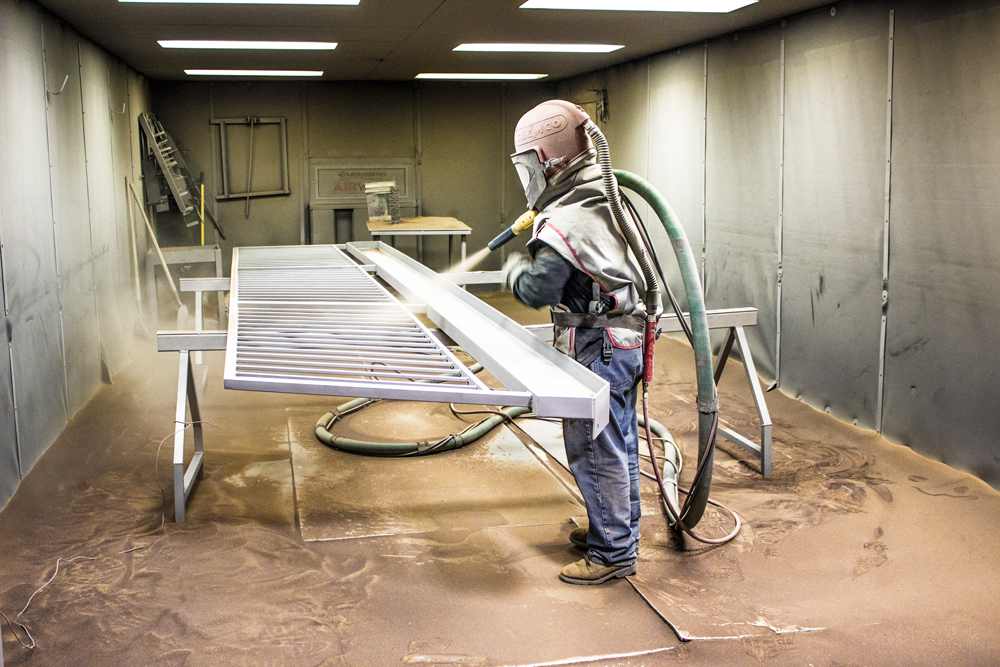
Not your Typical Pretreatment
If you have ever been involved in a conversation about pretreatment for powder coating, you would invariably hear words such as stages, immersion, bath, chemistry, pH, phosphate, water-break-free, and maybe even flocculate. These are all terms that apply to chemical pretreatment. This process involves the use of immersion or spray (or wipe on) chemical pretreatment. In our case, abrasive blasting and the terms used to convey the varying degrees of surface cleanliness are also worthy of understanding and use in our work as custom powdercoaters.
According to Powder Coating: The Complete Finisher’s Handbook (2004, Vol.3, Powder Coating Institute), pretreatment is defined as “the preparation of a part prior to the application of powder coating in order to improve adhesion and corrosion resistance” (p. 477). While chemical pretreatment achieves this by either etching the substrate or adding a thin film to promote adhesion and corrosion resistance, abrasive blasting only removes material from the top layer of the substrate. As a result the exposed raw steel is highly reactive with its environment as there is no chemical passivation to prevent corrosion. On the positive side, the metal is also free of oils, soils, mill scale, or rust that was their prior to blasting. (It should be noted in the case of salts, these should be removed with a wash prior to blasting).
In light of the controlled system afforded by the chemical pretreatment how does a custom coater prevent premature failure before the coating is even applied once the product has been blasted?
Blasting Basics
Before addressing the question of how to avoid premature failure after blasting, it's important to have a basic understanding of two key terms: Blast Cleanliness and Anchor Profile.

Blasting Cleanliness
Abrasive blasting has been a preferred surface preparation for liquid applicators for years. It is such a vital component of the engineered coating system, in fact, that there are three classification systems that we will likely see referenced in North America provided by the following standards bodies: NACE (www.nace.org), SSPC (www.sspc.org), and ISO (www.iso.org). Following is a table that provides a brief overview of the standard designation. It is worth noting that SSPC and NACE have published these as joint standards. In the case of the ISO standards, there is rough approximation to the NACE/SSPC standards, but they should not be considered equivalent.


These standards all outline the varying degree of surface cleanliness that is acceptable after the steel has been blasted (there is also a standard available for the blasting of non-ferrous metal and hot dip galvanized metal – SSPC-SP16). The requirements that the end user has for the product will determine what degree of surface cleanliness is required prior to coating, however it is my opinion that anything less than a commercial blast (SSPC-SP6) is insufficient preparation for powder coating for all outdoor applications.
The problem posed by using only a brush blast (SSPC-SP7) is that “tightly adherent mill scale, rust, and coating may remain on the surface” after the blasting is completed (See the attached article for more information on Mill Scale and Powder Coating). Coating over any of these three things will likely result in premature coating failure unless the refinished product is stored in a controlled environment that eliminates corrosion – an example being air conditioned room that is rarely used such as a computer server room.
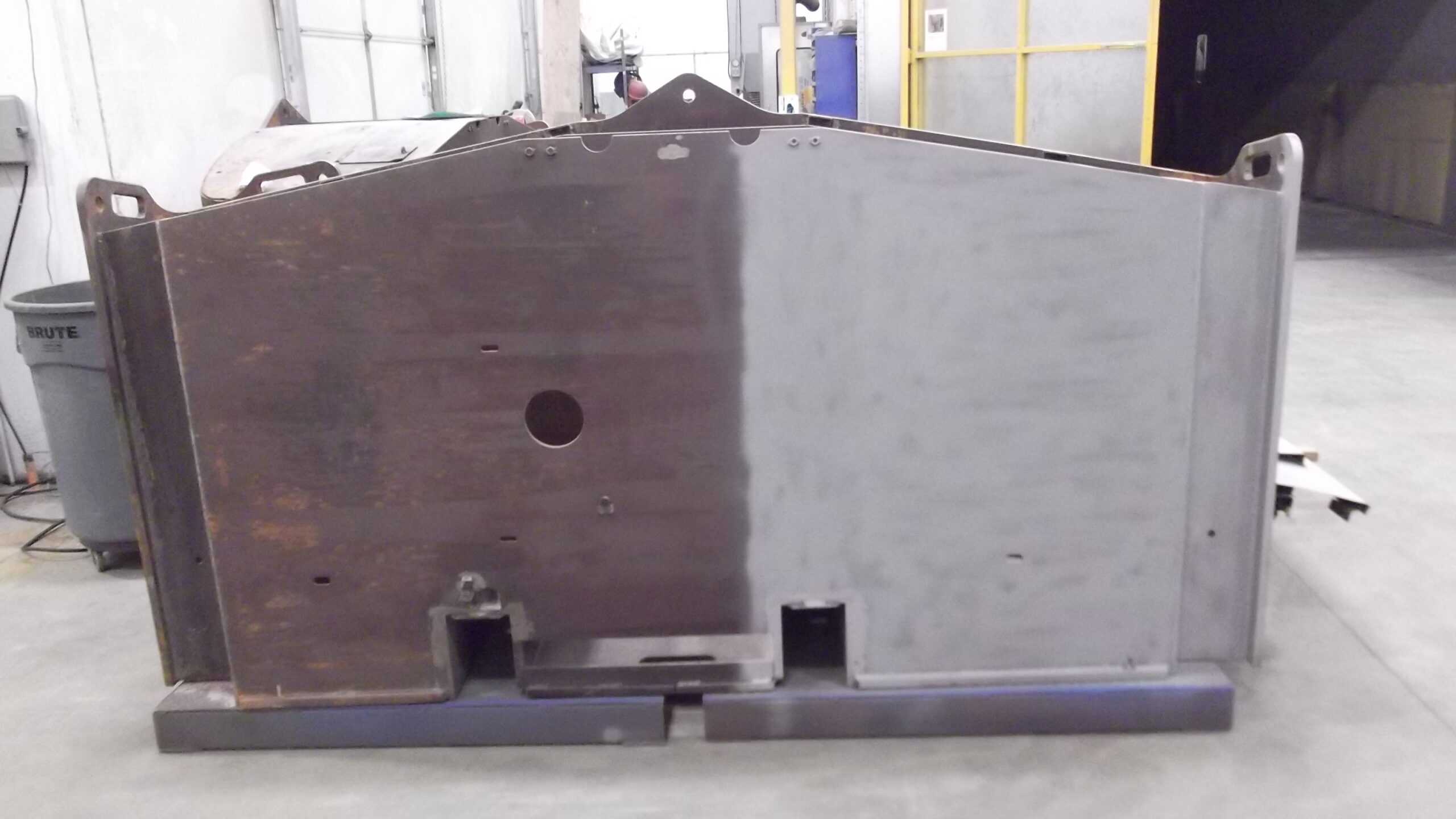
An excavator counterweight illustrates the difference between a SSPC-SP10 Near White blast (right) and unblasted surface (left)
Anchor Profile
One of the aspects of abrasive blasting that is not spelled out in the aforementioned standards is the anchor profile. For arguments sake, before steel is blasted the surface is flat – there are no peaks or valleys in the surface of the metal. Once it is blasted, peaks and valleys are created which effectively increase the surface area of the metal. This increases the surface area to which the coating bonds, and as mentioned above, exposes clean bare steel. Blast profile means the measurement from the peak of the highest point to the lowest point. The blast profile can and should be measured to ensure that the proper film build is applied to fill in the valleys and cover the peaks.
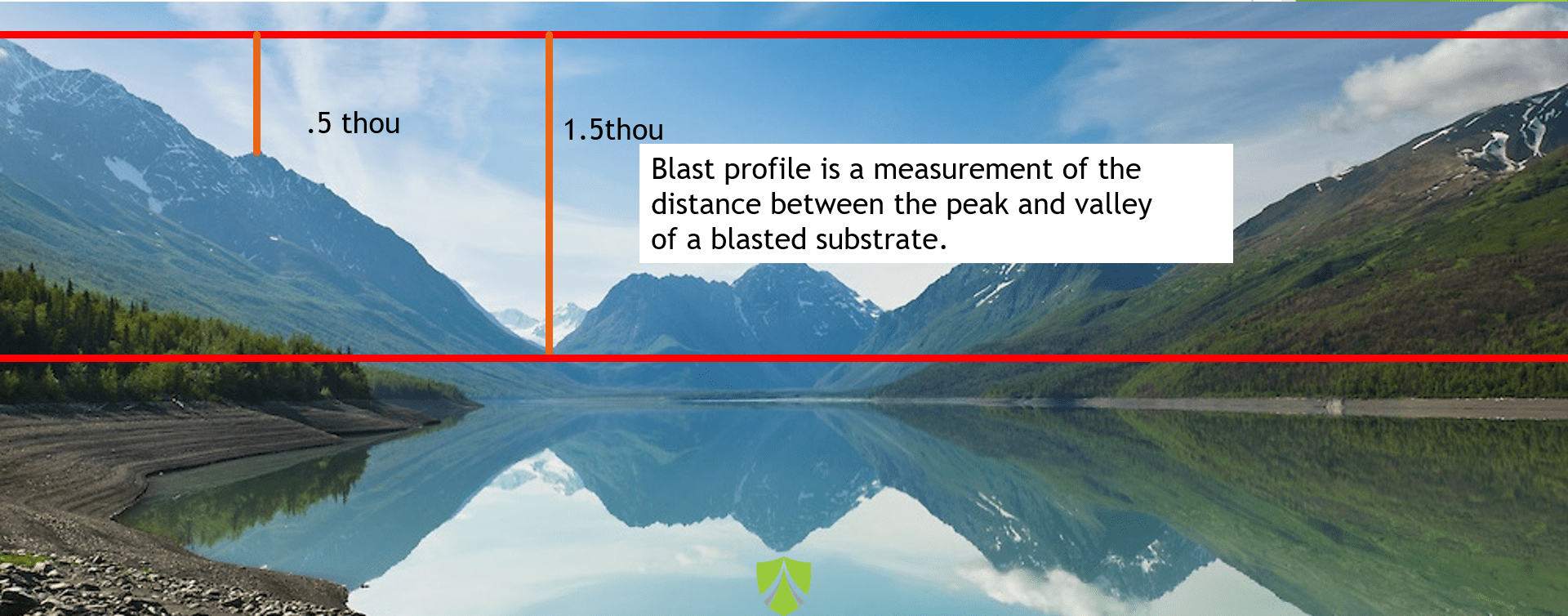
The depth of the blast profile will be affected by the size and shape of the media and the pressure at which it is forced out of the blast nozzle. A thorough discussion of blast media and appropriate profiles is beyond the scope of this article – for further information I suggest speaking with you coating supplier to find out what they recommend for their coating/lining, and your blast media supplier and your local abrasive blaster.
A Tale of Two Tests
Going back to the definition of pretreatment introduced at the beginning of this article, corrosion and adhesion are the two main elements of the coating system that should be improved as a result. The two tests referenced in this article speak to these elements directly.
Adhesion Testing
Using ASTM D4541 Test Method E – Standard test method for Pull-Off Strength of Coatings Using Portable Adhesion Testers, our company conducted pull off adhesion tests using the same adhesive for each instance of testing. The two coating systems are broken out in the following table. For the purpose of this article, the qualitative results will be the focus.
Coating System A Substrate: Hot Rolled Steel Plate Surface Prep: SSPC-SP10 Near White Blast Base Coat: Epoxy Primer (2.5 – 3.5mil DFT) Top Coat: Polyester (2.5 – 3.5mil DFT) | Coating System B Substrate: Hot Rolled Steel Plate Surface Prep: SSPC-SP1 Solvent Wipe Base Coat: Epoxy Primer (2.5 – 3.5mil DFT) Top Coat: Polyester (2.5 – 3.5mil DFT) |
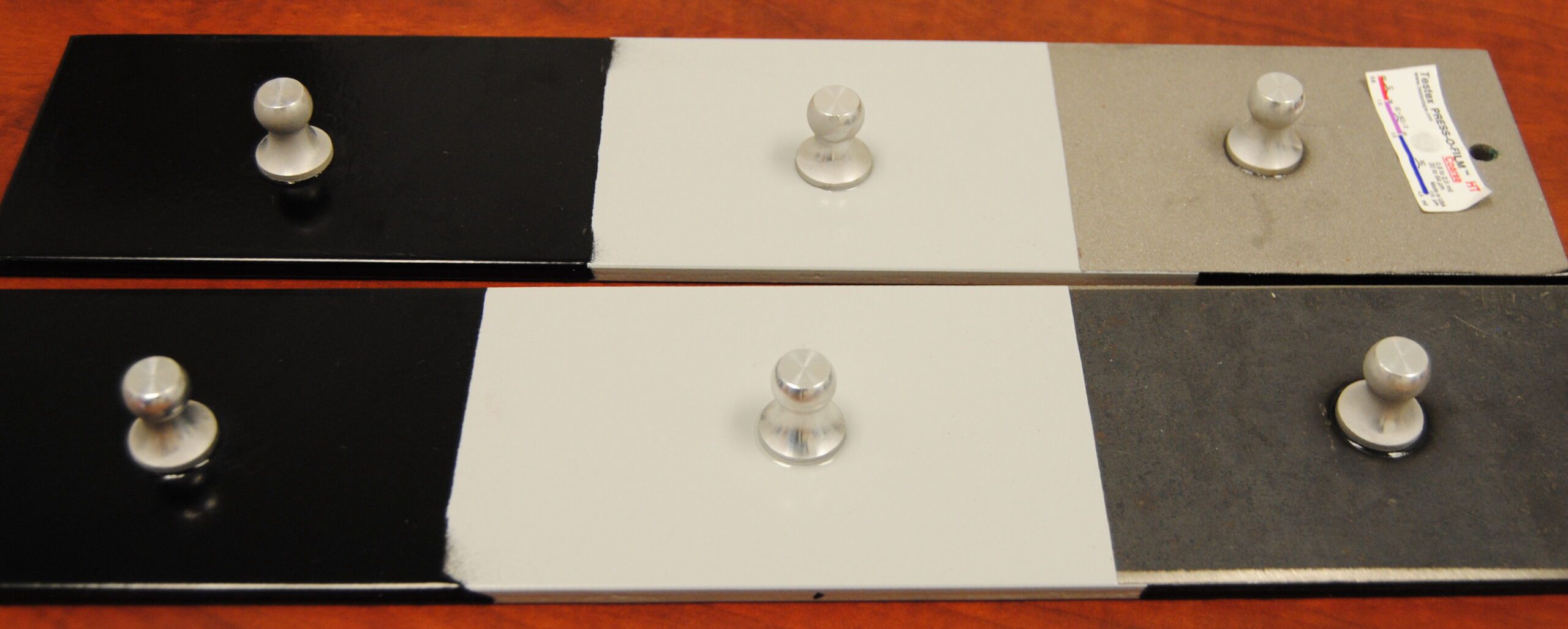
Coating System A (top) and Coating System B (bottom) are shown prior to administering the pull off adhesion test
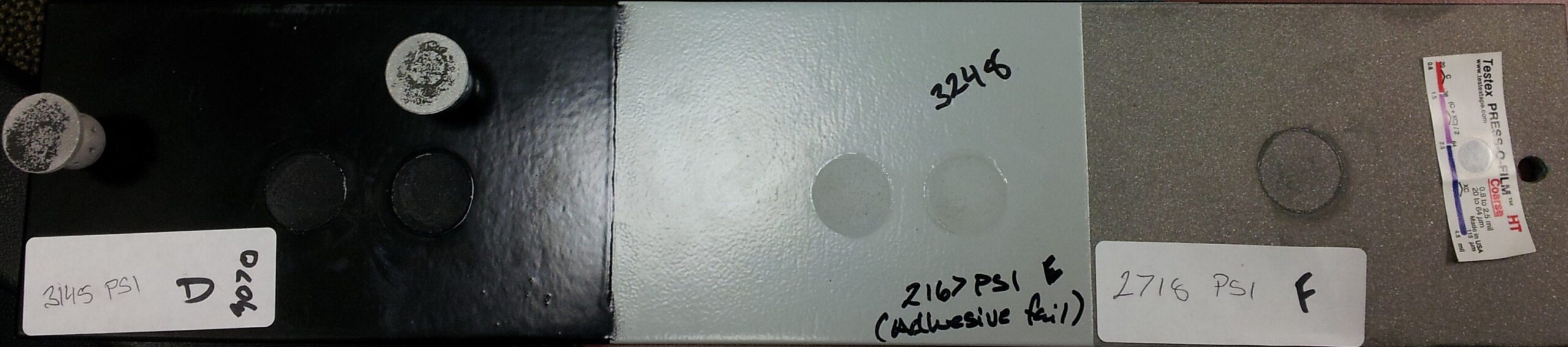
Coating System A after the pull off adhesion test
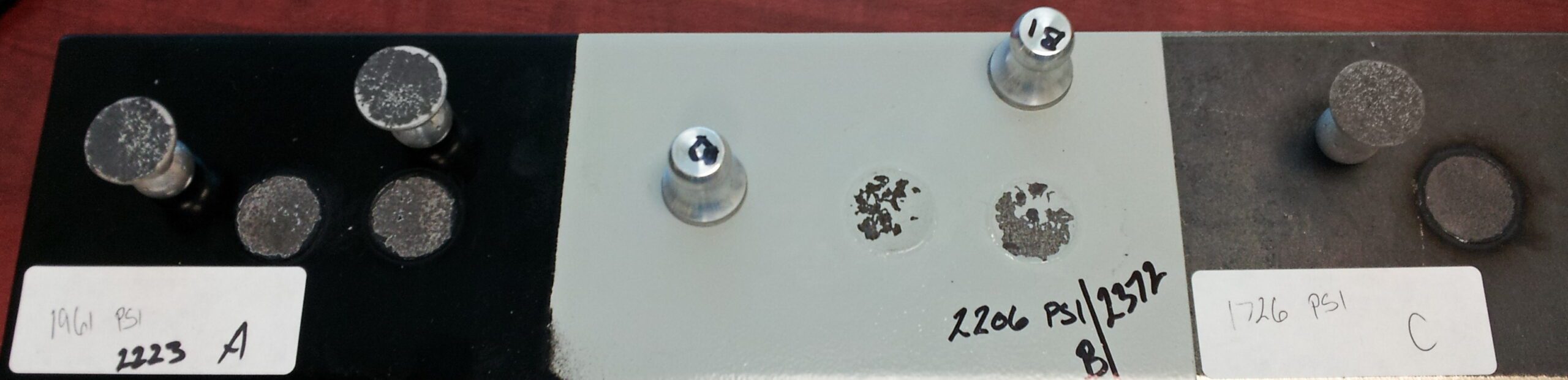
Coating System B after the pull off adhesion test
In the case of Coating System A, in all instances the failure occurred around the 3000psi range (which is the upper limit of the 20mm adhesion dolly’s which were used). Only in the case of the top coat was there some noticeable cohesion failure of the top coat. In further testing with a stronger adhesive and higher rated 14mm dolly’s we experienced the same type of failure at the range of 5000psi. I stress – at no point was there adhesion failure between the blasted steel to the primer, nor adhesion failure between the epoxy primer and the top coat.
In the case of Coating System B (solvent wipe over HRS), we did not experience coating failure, but instead saw the mill scale separate from the mild steel plate at around 2100psi. What is interesting here is that even with a solvent wipe and two coat system, the coating adhesion is greater than the bond of the mill scale to the base metal. The failure in Coating System B was not the coating, but instead the metal to which the coating was applied.
In the book, Corrosion Prevention by Protective Coatings, Munger and Vincent state that “irrespective of most of its other properties, the coating with very strong adhesion to the surface will retain its integrity much longer than one with less adhesion but other strong characteristics.” (C. Munger, L. Vincent, 1999, NACE International, P.50).
In both cases it would appear that adhesion over a solvent wiped surface and a blasted surface is similar in performance.
However, the corrosion test will reveal something entirely different.
Corrosion Testing
Using ASTM B117 Standard Practice for Operating Salt Fog Apparatus, Aegis partnered with a major coating supplier to test a variety of coating systems on hot rolled mild steel plates. The duration of the test was 4032 hours, or 168 days. For those who are not familiar with the test, the standard requires that the pieces be placed in a cabinet for a predetermined amount of time and subjected to a constant salt fog at 95F and a pH of 6.5 – 7.2. The test panels were evaluated every 168 hours.
The sample plates that we submitted for testing were all coated with the same exterior grade polyester top coat, and only the surface preparation and presence of the epoxy primer were the differing factors in the coating system used. Just before being put into the salt spray chamber, each sample plate was cut vertically down to the substrate to introduce a starting point for corrosion.
This test does not correlate to any particular real world environment, and instead should be used as a reference point when evaluating the suitability of a coating system for a particular application and environment. In the case of this article, the results are simply meant to demonstrate a qualitative difference between abrasive blasting as pretreatment and a simple solvent wipe.
Following are three test specimens that were subjected to the salt spray chamber:
Panel ID | Film Thickness | Hours Exposed | Undercut Rating | Surface Prep | Epoxy Primer | Result |
A | 3.1 – 3.4 mils | 504 | 1” | SSPC-SP1 | N | Failure |
B | 7.5 – 8.2 mils | 4032 | 1 ¼” | SSPC-SP1 | Y | Failure |
C | 7.8 – 8.0 mils | 4032 | 1/32” | SSPC-SP6 Commercial Blast | Y | Pass |
D | 2.9 – 3.1 mils | 1344 | <1/32” | SSPC-SP6 Commercial Blast | N | Failure |
Sample plate A and B both presented as failures once the testing was complete. The difference in time between them can only be attributed to the presence of the epoxy primer, which is an integral part of the coating system that was used in the abrasive blasted sample C. In D, the sample plate was pulled after 1344 hours due to too much corrosion showing up on the face of the panel; while it was not a fail due to coating undercut, the panel exhibited too much corrosion to carry on. This is a result of the coating thickness not being enough to cover the blast profile – and hence a very clear example of why a single coat over a blasted surface is likely not a good idea.
Only one of the sample plates passed after 4032 hours of exposure to salt spray hours – the plate that was blasted to an SSPC-SP6, and coated in an epoxy primer and a polyester top coat.
But the question of preventing failure once the bare steel is exposed after blasting has still not been addressed.
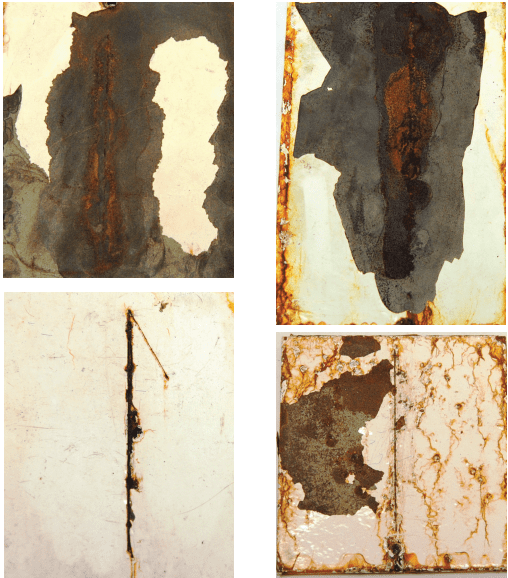
Sample plates A (top left), B (top right), C (bottom left) and D (bottom right) are shown after testing using ASTM B117
Special Considerations to fight corrosion
In conclusion to this article quality control must be addressed, when preparing and handling pieces for blasting any oil or grease on the surface of the piece to be blasted must be removed prior to starting. Failure to do so will contaminate the abrasives used as well as deposit the oil on the piece as it is being blasted and any other pieces done in the same media.
Once part has been blasted it should be coated within eight hours. Depending on the relative humidity of the area that you are in this window may change, but even if corrosion is not a concern, there are other contaminants that can negatively impact the part prior to coating. The blasting should occur in the same facility as the coating to minimize any chance of introducing causes of failure. If this is not possible, it is worthwhile collaborating with your blaster to make sure that your requirements for material handling and shipping are clearly understood and followed.
All it takes is one oily hand on a freshly blasted part to ruin a coating after it is cured. And the cost of rework is always going to outweigh any profit held in a job. Even once the job is on the truck, even if it is in an enclosed truck, should shipped on warm dry days to avoid introducing condensation on the surface of the part.
When used as part of a properly designed coating system, abrasive blasting as pretreatment will provide your customers with a lasting finish that leverages the performance of powder coatings.
Looking for More Information?


